Porto to Lisbon Train — From the Douro to the Tagus
The 336 km Linha do Norte carries Portugal's Alfa Pendular high-speed train from Porto's granite riverfront down to Lisbon's Tagus estuary in as little as 2 hours 42 minutes, connecting two of Portugal's largest cities past two of the country's most photographed azulejo-tiled stations along the way.
The Porto to Lisbon Train Journey
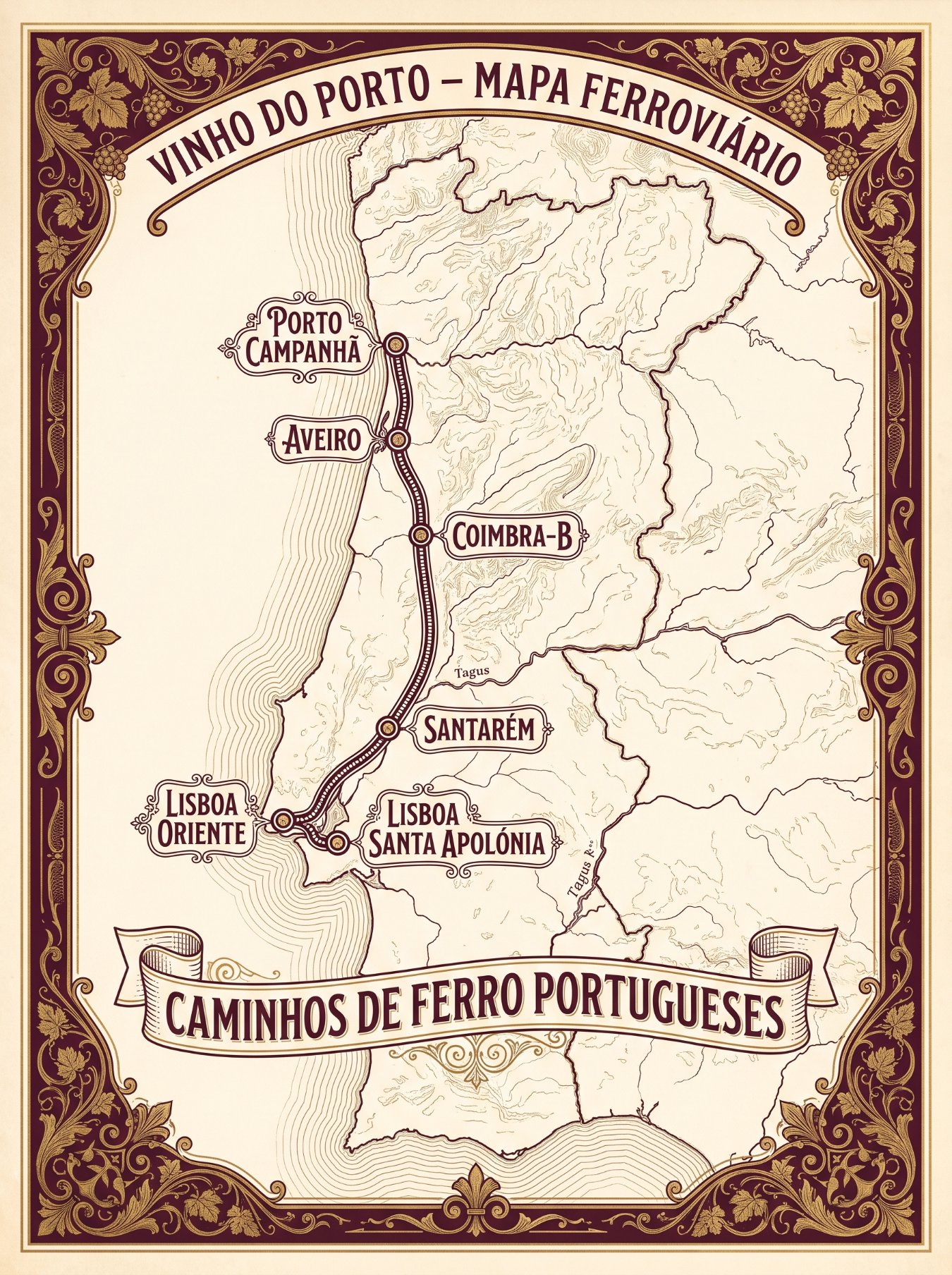
Every Porto to Lisbon train runs the length of the Linha do Norte, Portugal's original north–south rail corridor and part of the wider Portuguese railways network, opened in stages during the 1860s and 70s and still one of Western Europe's most useful stretches of track. Leaving Porto, the line crosses the Douro and heads south past Aveiro's canal-side lagoon, the university city of Coimbra, and the charming villages and open farmland around Santarém, before dropping into the Tagus valley for the run into Lisbon. It's a genuinely scenic 336 km train ride connecting two of Portugal's largest cities, not just a fast way to close the distance.
- The high-speed Alfa Pendular covers that distance in as little as 2 hours 42 minutes, with average journey time across both train services running up to about 3h15.
- Comboios de Portugal operates the Alfa Pendular and Intercidades train service on this line, keeping a fairly steady timetable across the day.
- The route runs from Porto Campanhã straight through to Lisboa Santa Apolónia via Lisboa Oriente Station — booking a little in advance keeps your pick of seats on both ends.
Following the Lisbon Route, Stop by Stop
Starting the Journey in Porto
Porto sits on granite bluffs above the Douro, and the city's identity is tied up in that river as much as the ocean it feeds into. Across the water in Vila Nova de Gaia, port wine has aged in riverside cellars for centuries — the drink that gave the city, and the train ride, its name. It's worth building an extra morning into your trip before boarding, whether that means the Ribeira waterfront, the Dom Luís I bridge, or just a coffee near São Bento's tiled entrance hall.
Before you board
- Porto Campanhã is the long-distance terminus — plan to be there, not São Bento, unless you factor in the connecting local train.
- São Bento's entrance hall is lined with roughly 20,000 historic azulejo tiles — worth a stop even if you're not catching a train there.
- Vila Nova de Gaia's port wine cellars sit a short walk across the Dom Luís I bridge from the Ribeira riverfront.
- Porto's granite-built center is compact enough to see much of on foot before an afternoon departure.
Alfa Pendular Train vs Intercidades: Which Porto to Lisbon Train to Take
CP runs two train types on this line — AP (Alfa Pendular) and IC (Intercidades) — both with a comfortable ride and modern amenities; the difference is speed, stops, and price.
| Service | Journey time | Stops | Onboard | |
|---|---|---|---|---|
| Alfa Pendular | As fast as 2h42, usually 2h45–2h55 | Fewest — Aveiro, Coimbra-B, a handful of others | Tilting EMU (up to 220 km/h), café-bar, power sockets, Wi-Fi | Check fares → |
| Intercidades | Around 3h to 3h15 | More frequent stops along the Linha do Norte | Standard EMU, café-bar, power sockets — lower fares | Check fares → |
Porto and Lisbon Train Stations Guide
Each city has two stations worth knowing — one modern and convenient, one older and worth a look on its own. Most trains call at both, so choosing a station comes down to convenience.
Porto Campanhã Station & Porto São Bento Station
Porto Campanhã is the departure station for long-distance Porto to Lisbon services — it sits right next to the Campanhã bus station, one of Portugal's busiest intercity bus hubs, so onward connections are easy. Porto São Bento, the beaux-arts station in Porto's historic center lined with roughly 20,000 azulejo tiles depicting scenes from Portuguese history, isn't served directly by Lisbon-bound trains — reach Campanhã first by a quick connecting local train, usually covered by the same ticket. Both stations connect to the city's metro network and have taxi ranks outside.
- Porto Campanhã: Largo da Estação, 4300-173 Porto
- Porto São Bento: Praça Almeida Garrett, 4000-069 Porto
Lisboa Oriente Station & Lisboa Santa Apolónia Station
Trains from Porto call first at Lisboa Oriente Station — officially Gare do Oriente, built for Expo '98 — inside the modern Parque das Nações district, which connects directly to Lisbon's metro Red Line, plus airport bus routes, with bus and taxi ranks right outside. A few minutes later they reach their final destination at Lisboa Santa Apolónia, Lisbon's oldest railway terminal (opened 1865), right on the edge of Lisbon's city centre and a short tram ride from Alfama and the riverfront. Pick whichever sits closer to where you're staying — most Alfa Pendular and Intercidades trains stop at both.
One clarification worth making: Lisbon's Rossio station handles the suburban commuter line out to Sintra, not Porto-bound Alfa Pendular or Intercidades services — if a map or hotel points you to Rossio, that's a different, shorter-distance train than the one covered on this page.
- Lisboa Oriente Station: Av. Dom João II, 1990-233 Lisboa
- Santa Apolónia: Av. Infante Dom Henrique 1, 1100-105 Lisboa
Public Transport at Porto and Lisbon Stations
Getting to and from either end is straightforward without a car. In Porto, the metro's E (violet) line stops right at Campanhã and continues into the city center and São Bento in about ten minutes, and local buses and taxis line up outside both stations; drivers dropping someone off will find short-term parking near Campanhã, though the lot fills fast during peak departures. In Lisbon, Lisboa Oriente Station sits on the metro Red Line with direct service toward the airport and the city center, while Santa Apolónia connects by tram, bus, and a taxi rank right at the entrance — most travelers skip renting a car for either leg of a Porto to Lisbon trip.
Train, Plane, or Car From Porto to Lisbon?
Over a 336 km distance connecting these two cities — among Portugal's largest and most visited — train, plane, car, and bus land in a similar time bracket door-to-door for the same trip, but not with the same amount of hassle, and once airport transfers are counted in, flying's travel time compares poorly with stepping straight off the train in a city center.
By train
2h42–3h15 door-to-doorBy plane
~3–4h door-to-doorBy car
~2h50 door-to-doorBy bus
~3h15 door-to-doorLuggage Allowance on the Porto to Lisbon Train
CP keeps luggage rules simple on Alfa Pendular and Intercidades — one bag free, sized to actually fit on board.
- One bag free — as long as it fits in the racks or under your seat without blocking the aisle.
- Max size 85 × 55 × 35 cm per item — roughly the size of a standard checked suitcase.
- Extra bags cost extra — additional items count as excess luggage, with Intercidades charging around €6.50 per item.
- Storage on board — overhead racks for small bags, larger racks near the doors for suitcases, and space by your seat for anything smaller.
Nobody weighs or measures bags at the platform in practice, but sticking to the limit keeps you clear of the racks — and the charge.
Tips for Booking Your Porto to Lisbon Train Ticket
Book Train Tickets Early for Cheap Fares
CP's cheapest tickets sell out first, especially around peak hours on Friday afternoons and Portuguese holidays. Booking a week or more ahead usually gets the lowest second-class price, whether you need a one-way fare or a return ticket for a same-day trip. Tickets purchased online arrive as an e-ticket with no hidden booking fees — keep it handy on your phone, since conductors check it on board.
First class vs second class
First class on Alfa Pendular adds wider seats and a bit more quiet for a modest fare bump — either travel class comes with comfortable seats and a reserved spot. Seat reservation is mandatory and included either way, on both Alfa Pendular and Intercidades — no separate fee.
First Train to Last Train: Porto to Lisbon Train Times
Most days run from around 6:30am to 10pm, roughly every one to two hours, so there's rarely a long wait for the next trains, with discounted tickets for young people, seniors, and families booking together. Arrive early too — platforms aren't posted until close to departure.
Rail Pass or Single Tickets?
Portugal's Alfa Pendular and Intercidades aren't covered by a dedicated domestic rail pass, but if you're also traveling through multiple countries in Western Europe, a Eurail or Interrail pass may be worth pricing out — otherwise single tickets through the search above are usually simpler and about as cheap.
Accessibility on the Porto to Lisbon Train
CP's Integrated Mobility Service (SIM) covers boarding, the journey, and getting off — arranged ahead of time.
Request SIM assistance
Submit CP's SIM request form or call ahead — at least 6 hours before departure, or by 8pm the day before for early-morning trains.
Staff meets you at the station
Once CP confirms the request, someone is ready at the platform at both Porto and Lisbon to help.
Board via wheelchair lift
Alfa Pendular trains carry a lifting mechanism built in, so boarding happens straight from the platform.
Reserved space on board
Alfa Pendular has two adapted wheelchair spaces, and both services offer accessible seating in second class.
Frequently Asked Questions About the Porto to Lisbon Train
How long does the train journey from Porto to Lisbon take?
Over the 336 km Porto–Lisbon distance connecting two of Portugal's major cities, the train journey takes approximately 2 hours 42 minutes on the fastest Alfa Pendular service, and up to 3 hours 15 minutes on slower Intercidades departures. For comparison, driving via the A1 takes about 2 hours 50 minutes, and the average bus journey runs close to 3 hours 15 minutes — the train comes out fastest or tied in almost every case.
Which train station do I depart from in Porto, and where do I arrive in Lisbon?
You depart from Porto Campanhã, the departure station for all long-distance Porto to Lisbon services, right next to Portugal's Campanhã bus station and connected to the Porto metro; if you need Portugal's São Bento station instead, take the short connecting local train from Campanhã first. In Lisbon, the train calls at Lisboa Oriente Station before reaching its final destination at Lisboa Santa Apolónia a few minutes later — pick whichever sits closer to where you're headed.
How Often Do Trains to Lisbon Run?
Comboios de Portugal's Alfa Pendular and Intercidades trains depart roughly every one to two hours, with the first train around 6:30am and the last train near 10pm — so there's rarely a long wait for the next trains, even without checking train times in advance. Counted just as direct departures on this specific route, that's roughly 15 to 19 trains a day. Counting the wider Linha do Norte corridor, including shorter regional segments, trains from Porto to Lisbon run 38 times daily.
How much do Porto to Lisbon train tickets cost?
Ticket prices for second-class fares start from around $32 for off-peak Intercidades departures, with most Intercidades tickets running $40–60 and Alfa Pendular fares roughly $46–76, tickets to Lisbon costing more during peak hours and around holidays. Promo tickets can cut the standard price by more than half when booked 5 to 60 days ahead, which is usually the easiest way to find the cheapest tickets.
What Are the Ticket Prices for the Porto to Lisbon Train?
Ticket prices for the Porto to Lisbon train start from around $32 for the cheapest available fare, with most Intercidades tickets running $40–60 and Alfa Pendular fares roughly $46–76 in second class. The fastest journey takes 2 hours 42 minutes, though slower or connecting options can take up to about 4 hours 42 minutes — ticket prices generally track with speed and time of day.
Are there promo fares or a rail pass for this route?
Yes — CP's promo fares can cut the standard second-class price by more than half if you book roughly 5 to 60 days ahead, plus separate youth, senior, and family discounts booked directly with CP. There's no dedicated domestic rail pass for Alfa Pendular or Intercidades, though a Eurail or Interrail pass can make sense if you're crossing multiple countries on the same trip.
What can I see during the train ride from Porto to Lisbon?
The train ride crosses the Douro leaving Porto, then passes Aveiro's azulejo-tiled station, the university city of Coimbra, and the charming villages and farmland around Santarém before the Tagus riverfront comes into view at the Lisbon end.
Can I visit Lisbon as a day trip from Porto?
Yes — the fastest Alfa Pendular gets you there in as little as 2 hours 42 minutes, so an early morning departure and a late-afternoon or evening return leave a full day in Lisbon. Just check the last return departure time before you commit, since services thin out in the evening.
Are there direct trains from Porto to Lisbon?
Yes — both Alfa Pendular and Intercidades run direct services from Porto to Lisbon on the Linha do Norte, with no transfer needed. Alfa Pendular calls at a handful of stops along the way, including Aveiro, Coimbra-B, and Santarém, while Intercidades stops more often. On the return leg, trains from Lisbon depart just as often, mirroring the same schedule back to Porto.
Are There Multiple Train Companies on the Porto to Lisbon Route?
No — unlike some European corridors served by several competing train companies, Porto to Lisbon has a single train operator, Comboios de Portugal (CP), running both the Alfa Pendular and Intercidades services covered on this page.
Where do I book train tickets for this route?
Unlike corridors served by multiple train companies, Porto to Lisbon has a single train operator, Comboios de Portugal (CP), so tickets typically arrive as an e-ticket regardless of which service you pick — search the box above to compare train tickets across Alfa Pendular and Intercidades and book through our partner with no extra booking fees. Keep the ticket handy on your phone, since conductors check it on board.
Do I need a seat reservation?
Yes — seat reservation is mandatory on all long-distance trains in Portugal, and it's included automatically with every Alfa Pendular and Intercidades ticket, so you'll have an assigned seat as soon as you book.
What amenities does the Alfa Pendular train offer?
As one of Portugal's fast trains, the Alfa Pendular train offers modern amenities across both travel classes — free wifi, power outlets, air conditioning, and comfortable seats, plus a café-bar. Intercidades trains are simpler but still include power outlets and a café-bar for a comfortable trip at a lower fare.
Is the train faster than driving or taking the bus from Porto to Lisbon?
Usually, yes. On the Lisbon Porto corridor, the train's average journey time is close to driving (about 2h50 via the A1) and shorter than the average bus journey (about 3h15), and unlike bus tickets or a car, the train drops you inside the city center at both ends — Porto Campanhã and Lisboa Santa Apolónia — with no motorway tolls or parking to deal with.
Is there a suburban train I should know about, like Rossio station?
Yes — Portugal's Rossio station in Lisbon handles the suburban commuter line to Sintra, which is a completely separate, shorter-distance train from the Porto to Lisbon service covered here. If you're connecting onward to Sintra, that's where you'd transfer, not at Oriente or Santa Apolónia.